Uncategorized • May 11, 2026

April Market Outlook 2026


April 2026 Market Outlook – Lower Eastern Shore Real Estate

Wicomico | Worcester | Somerset | Ocean City

April brought the Spring market fully into motion across Maryland’s Lower Eastern Shore—but not every area is moving the same way.

Some markets remain competitive with steady buyer demand. Others are seeing inventory grow faster than buyer activity.

That creates opportunities—but also requires strategy.


📊 Tri-County Overview

The overall market remains relatively balanced heading deeper into Spring.

Across Wicomico, Worcester, and Somerset Counties:

  • Inventory has continued to rise
  • Buyers have become more selective
  • Days on market are beginning to normalize after years of ultra-fast sales

This is no longer a market where simply putting a sign in the yard guarantees immediate activity.

Presentation, condition, pricing, and location matter again.


🌆 Wicomico County

Wicomico continues to be one of the strongest and most stable local segments.

Homes in desirable price ranges—particularly affordable and move-in-ready properties—continue to attract attention.

What we’re seeing:

  • Consistent buyer traffic
  • Strong activity in primary residences
  • Buyers becoming more cautious on overpriced listings

Well-prepared homes are still selling, but buyers are negotiating more carefully than they did during the peak frenzy years.


🌾 Somerset County

Somerset remains one of the Shore’s value markets.

Buyers looking for affordability, rural settings, hunting land, or waterfront opportunities continue to explore the county, but the pace remains slower than neighboring areas.

Current trend:

  • Longer market times
  • More negotiation
  • Buyers prioritizing condition and insurance costs

Sellers who price realistically are still finding success.


🌊 Worcester County (Excluding Ocean City)

The Worcester County market outside Ocean City continues to benefit from higher-end and lifestyle-driven buyers.

Water-oriented communities, retirement destinations, and second-home properties remain attractive—but buyers now have more choices.

Market shift:

  • Inventory growth is creating more competition
  • Buyers are comparing value carefully
  • Strategic pricing matters more than ever

The market is healthy, but no longer overheated.


🏖 Ocean City Condos

Ocean City condos continue to operate almost as their own independent market.

This segment currently has:

  • More available inventory
  • Increased competition between sellers
  • Buyers taking more time before committing

What this means:

Condition, updates, amenities, reserves, condo fees, and rental potential are all heavily influencing buyer decisions.

Properties that show well and are priced correctly still stand out. Others are sitting longer.


🧭 What Does This Mean for Buyers and Sellers?

The Shore market is becoming more balanced—and honestly, that’s healthier for everyone.

Buyers:

  • Have more choices
  • More negotiating power
  • More time to make decisions

Sellers:

  • Can still succeed
  • But need stronger preparation and pricing strategy

The days of simply “testing the market” are fading.


📞 Want To Know How Your Segment Is Doing?

The real question today isn’t:
“How’s the market?”

It’s:
“How is my neighborhood, property type, and price range performing?”

That answer changes from Salisbury… to Ocean Pines… to Crisfield… to Ocean City.

If you’d like a personalized look at your home, neighborhood, or buying goals, reach out anytime.

I’m always happy to help you understand the market without pressure.

Steady as the tide,
Bob the REALTOR®

Uncategorized • April 27, 2026

Spring Market Trends


📊 Maryland Market Trends – Spring 2026

Statewide, the story is pretty clear: buyers are back—but homes aren’t.

Home sales in Maryland dipped 4.4% year-over-year, not because of lack of interest, but lack of inventory. Prices continue to rise, with the average up nearly 5% to $513K and median at $430K. At the same time, pending sales jumped 8.7%, signaling strong demand heading into spring.

The challenge?
Inventory is down over 21% and new listings dropped nearly 25%.

That’s the pressure point—and it’s not easing anytime soon.


📍 Bringing It Home – Lower Eastern Shore

Wicomico County
Still the hub, with most activity falling in the $225K–$350K range, and a median hovering around the high $200s to low $300s. Buyers are active but selective. Homes priced right are moving—others are sitting longer than they used to.

Somerset County
Value-driven market, with many opportunities in the $150K–$275K range and a median typically in the low $200s or below. This is where first-time buyers and investors are finding their footing, especially with a little patience and negotiation.

Worcester County (Residential)
Stronger pricing overall, with most residential activity in the $300K–$500K+ range, depending on proximity to water and amenities. Median prices tend to sit in the mid-to-upper $300s. Condition and presentation are key here—buyers expect value for the price point.

🌊 Ocean City Condos
A different lane, generally ranging from $250K to $600K+, heavily influenced by rental potential and location. This segment moves with interest rates and investor confidence more than anything else.


💡 The Takeaway
This isn’t a slowdown—it’s a supply-driven market. Demand is there, but choices are limited.

For sellers: opportunity.
For buyers: strategy matters more than ever.

If you’re thinking about making a move, let’s talk through what this market means for you.
Steady as the tide.

Uncategorized • March 3, 2026

Underground Water Appreciation Week

BTR FYI: Why We Should Pay Closer Attention to Our Water Sources

Your water matters — and here’s why

Water is essential — for life, for families, for farms, and for our local economy. During Groundwater Awareness Week we’re reminded of something both simple and profound: the water beneath our feet sustains much of what we depend on every day. Groundwater feeds private wells, supports streams and rivers, and connects with surface waters that recharge public systems. But here in Wicomico County, that groundwater isn’t always as pristine as we hope — and that has real consequences for families and renters alike.

Groundwater Can Be Vulnerable — Here’s Why

Most rural and private water supplies in our region come from shallow aquifers — water-bearing layers close to the ground surface. While this makes wells accessible, it also makes them susceptible to contaminants moving downward from the surface. Septic system failures, runoff from fertilized lawns and agricultural fields, and industrial activities can carry nutrients, bacteria, and chemicals into the water that ends up in our wells.

That’s especially concerning because once contaminants enter groundwater, they don’t just disappear. They move with the water flow and can affect multiple wells and properties over time.

PFAS “Forever Chemicals”: A Major Local Concern

One of the biggest local challenges is PFAS contamination — the so-called “forever chemicals” linked by health experts to various risks including certain cancers, liver and kidney stress, and other health impacts:

• Elevated levels of PFAS have been detected in groundwater near the Perdue AgriBusiness facility in Salisbury, prompting ongoing testing, mitigation, and community concern.
• Local lawsuits and community meetings reflect continuing worries about how far these contaminants may have spread and whether current mitigation is sufficient.
• Residents have reported needing bottled water or filtering systems while questions about health impacts and long-term cleanup continue.

While public water systems like the City of Salisbury’s municipal supply currently meet all regulatory standards, private wells — which many rural residents rely on — are not covered by the same federal protections.

Drought & Supply Issues Add Another Layer

Beyond contamination, water supply itself can be vulnerable. Periods of drought reduce groundwater recharge, stress surface water flows, and change how contaminants move underground. Awareness of both quantity and quality is essential for long-term resilience.


What This Means for You

1. Know Your Source — And Its Risks

If you depend on a private well, stay informed about local land use and water quality trends. Regular, comprehensive testing (beyond basic bacteria checks) can catch problems before they escalate.

2. Surface Activities Affect Underground Water

Every septic system, lawn fertilizer application, or industrial discharge contributes to the bigger groundwater picture. Pollutants don’t vanish — they migrate.

3. Advocacy & Engagement Matter

Public awareness and local policy — from monitoring networks to sewer and water infrastructure planning — help protect both water quality and community health.


Landlord Responsibilities for Safe Drinking Water

If you rent a home in Maryland — especially one served by a private well — there are specific legal protections designed to ensure your water is safe and drinkable:

✨ Landlords must provide functional hot and cold running water, as part of basic habitability requirements.
✨ For homes served by private wells, Maryland’s law (House Bill 1069) requires:
• Water quality testing at least every three years, with results shared with current and prospective tenants before a lease is signed.
• If testing shows contaminants above safe levels, landlords must notify state and local agencies, provide an approved potable water supply while the issue is fixed, and resolve the problem within 60 days — or give the tenant the option to end the lease.
✨ Failure to meet these requirements can result in civil penalties.

These protections recognize that private wells don’t fall under federal Safe Drinking Water Act oversight, so the state ensures renters aren’t left without safe water.


Groundwater Awareness Isn’t Just a Week — It’s a Priority

The health of our water affects our families, our environment, and our economy. Paying attention isn’t alarmism — it’s stewardship. When we understand where our water comes from, how it can be affected, and what protections are in place, we’re better equipped to protect ourselves and our neighbors.

💧 Because clean, safe water isn’t just a resource — it’s our right.

Uncategorized • February 20, 2026

Maryland Housing Forecast 2026


Maryland Housing 2026

After Sitting With the Numbers

By Bob Heim
Bob the REALTOR MD

Research Source: William R. McCain, MBA, MAI – Delmarva Outlook 2026


Every year I read through W.R. McCain’s Outlook slowly.

Not just the charts. Not just the percentages.
But the tone behind the numbers.

After digesting the 2026 report, one phrase kept surfacing for me:

Not “The New Norm.”

But something else.

The Old Normal.


What Was Forecast… and What Actually Happened

The 2025 outlook projected:

  • Modest appreciation
  • Slightly improving inventory
  • A cooling seller’s market
  • Mortgage rates easing just a bit

No crash. No frenzy. Just stabilization.

Looking at the actual 2025 numbers for Maryland’s Eastern Shore (page 54), that’s largely what occurred.

Wicomico up 6.1%.
Somerset up 9.4%.
Worcester up 1%.

But sales volume softened in several counties.
Days on Market increased (page 58).
Negotiation returned.
Discounts reappeared.

The frenzy faded.

Not because the market failed — but because it recalibrated.


The Assessments Tell the Same Story

Residential reassessments statewide (page 45):

  • 2023: +23%
  • 2024: +20%
  • Latest cycle: +13%

Still rising — but no longer surging.

That feels familiar.

That feels like how it used to be before historically low rates distorted everything.


The Structural Reality Remains

Maryland still faces:

  • A 96,000-home shortage
  • A projected need for 590,000 new housing units by 2045
  • Highly restrictive zoning
  • A large percentage of cost-burdened households

Those aren’t short-term fluctuations.
They’re long-term challenges.

And they continue to shape pricing and availability.


Alignment With National Economists

When you step back and compare McCain’s conclusions with national economists — Fannie Mae, NAR, Federal Reserve commentary — the alignment is striking.

  • Forecasted 2–4% appreciation? Yes.
  • Mortgage rates hovering near 6%? Yes.
  • Inventory slowly increasing? Yes.
  • Shift toward a balanced market? Yes.
  • Affordability as the dominant issue? Absolutely.

McCain reframes the three drivers of value as:

Affordability
Mortgage Rates
Location

That matches national economic consensus almost point for point.

There’s no dramatic divergence between local and national outlook. Maryland is not operating in isolation.


So What Is 2026?

It’s not “OK.”

It’s not booming.

It’s not collapsing.

It feels like I remember the market feeling before 2020.

Homes take time to sell.
Pricing matters.
Condition matters.
Buyers negotiate.
Sellers adjust.

Under $350,000 homes may still see stronger demand.
Higher price points may experience more pressure.

That’s not instability.

That’s equilibrium.

That’s the Old Normal.


Final Reflection

The last few years were abnormal.

Ultra-low interest rates.
Bidding wars.
Rapid double-digit appreciation.
Sellers dictating every term.

That was the outlier.

What we’re seeing now is a return to discipline.

A return to measured expectations.

A return to fundamentals.

People still move for the same reasons they always have — job changes, retirement, inheritance, family, quality of life. Especially here on the Eastern Shore.

The difference now?

The market requires strategy again.

And honestly… that’s how I remember it.

—

If you’d like to discuss how this “Old Normal” affects your property or buying plans, I’m happy to sit down and walk through it.

—
Bob Heim
Bob the REALTOR MD

Research credit: William R. McCain, MBA, MAI – Delmarva Outlook 2026


If you’d like, we can also create a short companion Facebook post that simply says:

“The frenzy wasn’t normal. This is.”

Uncategorized • February 6, 2026

Turning the Page to 2026:


A Realistic Housing Outlook for Maryland’s Eastern Shore

As we flip the calendar to 2026, the Eastern Shore housing market is settling into something we haven’t seen in a while:

A calm, thoughtful, locally driven market.

After years of rapid change, speculation, and headlines driven more by emotion than fundamentals, primary residential housing in Wicomico, Worcester, and Somerset Counties is now being shaped by real-life decisions again—jobs, affordability, lifestyle, and long-term planning.

This blog combines January 2026 inventory and sales trends with a broader look at where the market is heading this year, specifically for people who live here full time.


The Big Picture: What January 2026 Is Telling Us

January is often a quieter month, but it’s also a revealing one. Early-year activity tends to set the tone for what follows.

Across the Lower Eastern Shore, we’re seeing:

  • Inventory that remains tight, especially for well-priced primary homes
  • Buyers who are deliberate, not rushed
  • Homes selling steadily, but no longer on autopilot
  • Pricing accuracy and condition playing a much larger role

This is no longer a hype market.
It’s a decisions-matter market.


County-by-County Snapshot

Wicomico County: The Regional Anchor

Wicomico continues to function as the economic and housing hub of the Lower Shore.

In January 2026:

  • Median home prices remained in the upper-$200,000 range
  • Inventory stayed below long-term norms
  • Buyer demand remained steady, supported by healthcare, education, manufacturing, and professional services

Primary buyers here are focused on monthly payment comfort, not bidding wars. Homes that are well maintained and realistically priced continue to move, while overpriced or poorly prepared listings sit longer than they would have a few years ago.

Outlook for 2026:
Wicomico favors stability over speculation. It’s a healthy market for both buyers and sellers—when expectations are realistic.


Worcester County: Selective and Neighborhood-Driven

Worcester remains a split market, influenced by second homes and tourism, but primary housing tells a different story.

January activity showed:

  • Median prices around $450,000 for primary residences
  • Tight resale inventory in established communities
  • Buyers taking time to compare neighborhoods, HOAs, and long-term livability

Areas like Ocean Pines and the Berlin corridor continue to perform well for year-round residents, while homes that blur the line between vacation and primary use require clearer positioning.

Outlook for 2026:
Worcester rewards clarity. Primary homes that are priced and presented as year-round residences perform best.


Somerset County: Affordability with Intention

Somerset remains the most affordable entry point on the Lower Shore.

In January:

  • Median prices hovered near $200,000
  • Inventory was more available than in neighboring counties
  • Sales volume was smaller, but steady

Buyers here are often first-time homeowners or budget-conscious households, frequently using assistance programs. Condition, inspections, and financing readiness matter greatly.

Outlook for 2026:
Somerset is not an appreciation-driven market—it’s a value and stability market. The right guidance makes all the difference.


Themes Shaping 2026

Across all three counties, a few consistent patterns are emerging:

Affordability leads the conversation
Buyers are evaluating payments, not just prices.

Pricing accuracy wins
Homes that start at fair market value generate interest. Overpricing costs momentum.

Inventory remains constrained
Slight increases are possible, but supply is still lean compared to historic norms.

Buyers are informed and patient
Inspections, concessions, and financing strategies are back on the table.

This is a market that rewards preparation, transparency, and experience.


What This Means for You

If you’re buying:
You have time to make thoughtful decisions—but the best homes still move quickly when priced right.

If you’re selling:
You’re selling into a stable market, not a frenzy. Presentation, pricing, and strategy matter more than ever.


Final Thought

2026 is shaping up to be a balanced, realistic year for primary housing on Maryland’s Eastern Shore.
Homes are selling. Buyers are active. Sellers are succeeding—when expectations align with today’s market, not yesterday’s headlines.


Want a Deeper Dive?

I’ve prepared a detailed January 2026 Housing Outlook Report with:

  • inventory and sales by county
  • neighborhood-level insights
  • buyer and seller strategies for the year ahead

👉 Contact me directly and I’ll be happy to share it with you.

Bob the REALTOR®
Maryland’s Eastern Shore

Uncategorized • December 3, 2025

The Market Is Changing — Are You Ready for It?

Dear Friends,

I wanted to take a moment to share a real-world update on our local real estate market — not headlines, not hype — just the truth from inside the numbers.

Across Ocean City, Mainland Worcester County, and Wicomico County, one big trend stands out clearly:

Inventory is up — and the market is beginning to balance.

This November we’re seeing:

• Around 40–50% more homes for sale than last year
• Homes now taking about two months on average to sell
• Prices remaining surprisingly steady, especially in coastal and move-in-ready homes
• Luxury and waterfront properties still experiencing serious buyer activity

We’ve moved away from the frenzy of the last few years and into something healthier — a market that rewards preparation, realistic pricing, and good advice.


What This Means for Buyers

You finally have breathing room again.

Instead of walking into bidding wars and rushed decisions, buyers are now seeing:

✔ More homes to choose from
✔ Time to think before deciding
✔ Greater leverage during inspections and negotiations
✔ Opportunities to ask for help with closing costs or improvements

It’s not a “crash market.”
It’s a chance market — especially for people who waited patiently during the chaos.


What This Means for Sellers

Homes are selling — but strategy matters more than ever.

This is no longer a “list it and forget it” market.
Today’s success depends on:

✔ Correct pricing from the start
✔ Condition and presentation
✔ Understanding your competition
✔ Knowing how long a home should take to sell in today’s market (about 45–60 days)

The homes that sell are the ones that are:
• Clean
• Well-presented
• Correctly priced
• Properly marketed

And the ones that struggle?
They usually start too high and chase the market downward.


The Bottom Line

We are no longer in a panic market.
We are in a thinking market — and that’s a good thing.

Buyers can be thoughtful.
Sellers can be strategic.
And decisions are being made with clarity instead of pressure.

If you’ve wondered:

“Is now a good time to move?”
“Should I wait?”
“What is my home really worth today?”
“Could I buy without chaos again?”

…I’d be happy to talk — no sales pitch, just straight answers.

As always, thank you for trusting me with one of life’s biggest decisions.
I don’t take that lightly — and I never will.

Warm regards,

Bob
Bob the REALTOR®
Real estate advice you can trust — backed by real data, not noise.

Uncategorized • October 6, 2025

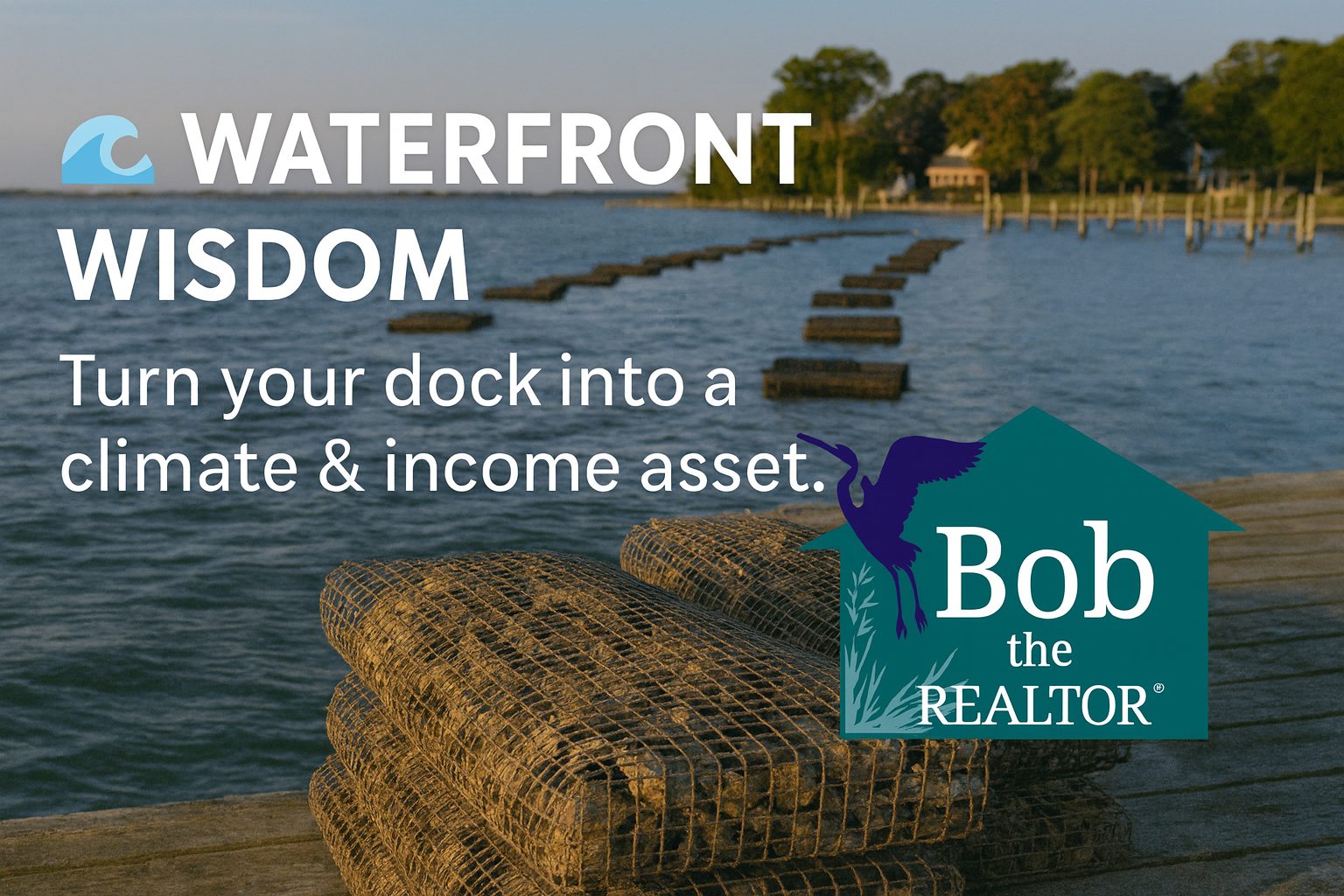
🌊 Waterfront Wisdom: Turn Your Dock into a Climate & Income Asset with Oysters


When you picture Somerset County’s waterfront, you probably see sunsets, crab pots, and the tide brushing the marsh. Yet these same waters can become an economic engine for the community. Even better, as a waterfront homeowner, you can play a role in this future.


The Oyster Advantage

Recently, HappyEcoNews highlighted oyster farming as both a sustainable protein and a natural environmental solution. Oysters filter water, trap carbon, and build reef systems that protect shorelines. Furthermore, every pound of oyster protein carries only a fraction of the carbon footprint of beef or chicken. Even while they grow, oysters literally clean the waters around them.

In Maryland, the story goes further. The state not only supports oyster restoration but also runs a credit program. Through this program, farmers earn income from the nutrients that oysters remove from the Bay. In other words, oysters are recognized as both food and environmental workers with financial value.


Why Somerset County Is Poised to Benefit

Somerset’s location along Tangier Sound and its rivers makes it ideal for oyster aquaculture. Additionally, the county already has leaseholders, processing facilities, and restoration sanctuaries. With these foundations in place, Somerset is well positioned to expand.

Picture this:

  • Local farms raising oysters that create jobs and credits.

  • A “Somerset Sound Oysters” brand boosting pride and demand.

  • Cleaner, clearer waters increasing property values and protecting shorelines.

  • Tourism, festivals, and school programs built around this resource.

This vision is not far off. In fact, it is a 5- to 10-year roadmap if we build steadily on the progress already made.


How Waterfront Homeowners Can Get Involved

If you own waterfront property in Somerset, you are not a bystander. Instead, you can be a front-line steward.

  • First, install oyster floats or cages at your pier through programs like Marylanders Grow Oysters (Maryland DNR).

  • Next, recycle oyster shells to support reef restoration (Oyster Recovery Partnership).

  • In addition, partner with growers or co-ops to help generate aquaculture credits.

  • Finally, monitor water quality and add science to your shoreline.

What do you gain? Cleaner water, less erosion, possible tax credits, and higher property values. On top of that, you gain the pride of knowing your slice of shoreline contributes to something much larger.


Call to Action: Be Part of Somerset’s Oyster Future

As a Somerset resident, you have the rare chance to align heritage, environment, and economy. Oysters can connect your past with your future — but only if you take action.

👉 If you are a waterfront property owner, start the conversation. Ask about oyster floats, shell recycling, or aquaculture cooperatives. Together, we can build a Somerset where clean water and strong communities thrive side by side.

The tide is rising. The real question is: will you ride it?

Uncategorized • July 28, 2025

🏡 When School Districts Matter — A Note from Bob the REALTOR®


As a REALTOR® serving Maryland’s Eastern Shore, I’ve helped many families navigate the homebuying process. One question that comes up again and again—especially for buyers with school-age children—is:

👉 “How are the schools in this neighborhood?”

I get it. As a parent and now a grandparent, I know how important educational opportunities are. In fact, according to a National Association of REALTORS® (NAR) study, over half of homebuyers with children under 18 consider the quality of school districts a major factor in choosing a home. But here’s the thing: answering that question isn’t as simple as giving a thumbs up or down.


🎯 My Role: Helping You Make an Informed Choice

When it comes to schools, my job is to give you tools, not opinions. I follow the Equal Professional Service Model outlined by NAR, which means I offer the same high-quality support to every client—consistently, ethically, and without steering. That’s especially important when we talk about school districts.

So instead of saying, “This is a good school,” I’ll connect you with trusted resources like:

  • GreatSchools.org
  • Local Board of Education websites
  • Maryland School Report Cards
  • Parent groups and school staff contact info
  • Neighborhood comparisons backed by objective data

You’ll get everything you need to evaluate what matters most—whether it’s test scores, student-to-teacher ratios, extracurricular programs, or special education services.


📊 School Quality = Neighborhood Value

Here’s another reason school districts matter: they directly affect property values. Studies have shown that every $1 spent on public schools increases nearby home values by about $20. Homes in high-performing districts often command a premium—sometimes 40–50% higher than similar homes in neighboring zones. It’s not just about education—it’s about long-term investment, too.


🧭 What a Typical Journey Looks Like

When you work with me, here’s how we’ll approach your school-conscious home search:

  1. We talk: You share your priorities for your child’s education and ideal home features.
  2. I send resources: You’ll get links to objective, third-party school data to review.
  3. We tour: I’ll show you homes both within and outside your preferred districts so you can compare options.
  4. You connect: I’ll help coordinate school visits or connect you with parent networks, if you’d like.
  5. We act: When you’re ready, I’ll guide you through the offer and negotiation process with confidence and transparency.

📣 Final Thought

Whether you’re focused on schools from day one or just beginning to consider their impact, I’m here to support you. I’ll never steer you—I’ll empower you with information so you can make the best decision for your family and your future.

✅ Let’s find a home that checks all the boxes—education included.
📩 Send me a message and let’s start your school-smart home search.

—

📍 Serving Wicomico, Worcester, and Somerset Counties
📞 Bob the REALTOR® | ERA Martin Associates